

“The idea that all white people systemically benefit from the colour of their skin, and in turn oppress people of a different skin tone, is a myth in opposition to the liberal ideal of individuality over group identity.” - John Kenny
I can see why people might believe that white supremacy only exists in overt acts: Richard Spencer giving the Hitler salute or uses of racial slurs. But they are wrong. White supremacy runs on the staunch denial that white privilege exists, as if the deep inequalities in our world were simply the result of a meritocracy. White supremacy gains momentum every time someone claims that the “myth of white privilege” is the real problem. With his finger on the pulse of the alt-right tactics, educator John Kenny gives white supremacy great momentum in his blog post Keep the myth of white privilege out of our schools.
Keep the myth of white privilege out of our schools https://t.co/B4d02mpdLQ pic.twitter.com/3JWbVOhTUd
— John Kenny (@JohnKenny03) March 10, 2018
I’m not really writing this to persuade Kenny he is wrong; changing his mind requires his hard work, not mine. His Twitter profile paraphrases David Foster Wallace about fish not noticing water. “Question everything.” Right.
Kenny whitewashes Martin Luther King Jr.’s legacy, much like Jonathan Haidt did in his recent attack on intersectionality, in what has become a familiar talking point of the alt-right:
“I think it’s amazing that the West, just generations ago and likely for the first time ever, has finally been able to put the rights of the individual first before group identity – racial or otherwise. The commitment to protect individual rights, even if this means suffering slight economic disadvantage, is the hallmark of liberal western society. This ideal is beautifully captured in Martin Luther King’s famous speech at Capitol Hill in which he shared his dream of equality of opportunity … It’s a beautiful dream… an ideal at the core of education systems everywhere. No matter who you are or where you are from, you will be treated equally and gain access to the same opportunity and be judged by your individual merit, not by your identity.”
While Kenny seems to believe that ‘just generations ago’, individual rights overcame racist systems, King (1967) called it a “fantasy of self-deception and comfortable vanity” on the part of “the majority of white Americans” to believe that America achieved the dream. Sincere Kirabo quotes MLK’s Where do we go from here? (1967) “Why is equality so assiduously avoided? Why does white America delude itself, and how does it rationalize the evil it retains? The majority of white Americans consider themselves sincerely committed to justice for the Negro. They believe that American society is essentially hospitable to fair play and to steady growth toward a middle-class Utopia embodying racial harmony. But unfortunately this is a fantasy of self-deception and comfortable vanity.”
In the whitewashing of King, he is presented as calling for a non-threatening colour-blindness, but it’s worth remembering that the FBI thought King was a “national security” risk, and tried to blackmail him into suicide. Edward Ongweso Jr calls the whitewashing of King a “second assassination” that happens when we fail to “celebrate the real Martin Luther King Jr.”: “an anti-war, anti-capitalist activist who called for direct action as much as nonviolence, democratic socialism as much as equality, and black identity as much as integration.” When Kenny talks about tolerating people “suffering slight economic disadvantage” in return for individual rights, he completely misses both King’s critique of capitalism and the ongoing racist economic injustice that is anything but ‘slight’. Ongweso quotes King’s critique:
“The misuse of Capitalism can also lead to tragic exploitation. This has so often happened in your nation. They tell me that one tenth of one percent of the population controls more than forty percent of the wealth. Oh America, how often have you taken necessities from the masses to give luxuries to the classes. “
Now, the top 0.1% in America holds as much wealth as the bottom 90%.
https://twitter.com/DJRarela/status/820688492841705472
https://twitter.com/DJRarela/status/820663958486953984
In his argument that ‘identity politics’ is dangerous, Kenny draws on statistics about university admissions often used by white supremacist sites like The Daily Stormer.this link is to a safe blog post, not the Stormer Kenny writes:
“For example, In the U.S, Asian students now have to score 280 points above black students for entry into the same college based solely on their group identity – an advantage if you are black; disadvantage if you are Asian. Deliberate discrimination against individuals on the basis of their group identity is identity politics.”
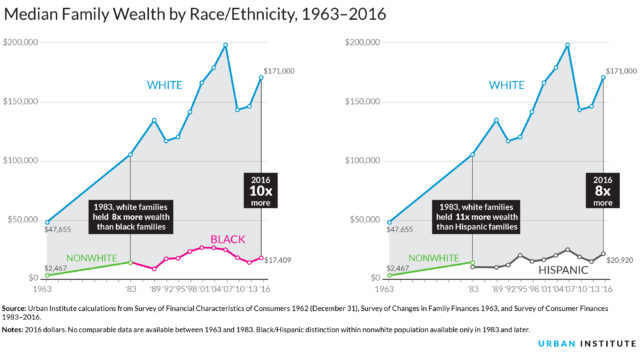
The article Kenny links to contains no link to the original study, so it takes some work to fact-check his claim. Before doing so, it’s worth noting the broader context of American universities and racism: “According to the surviving records, the first enslaved African in Massachusetts was the property of the schoolmaster of Harvard. Yale funded its first graduate-level courses and its first scholarship with the rents from a small slave plantation it owned in Rhode Island .” Alex Carp continues: “At its best, this wave of research demonstrates the ways in which slavery and its legacies have built the world we live in: how the ideas and institutions born in one era do not entirely cast off the forces that shaped them as they move through time.” As the charts about the wealth gap show, the ongoing of legacy slavery and the current practices of redlining perpetuate structural racism: “individual choices are not sufficient to erase a century of accumulated wealth: structural racism trumps personal responsibility.” When people deny white privilege, it’s the ultimate identity politics of white supremacy at play.
As for the study that Kenny alludes to, it’s likely this paper from 2004 that uses data from the mid 1990s. More comprehensive analyses make a few facts clear. When Asian American students are treated unfairly, Daniel Golden shows that it’s not because Black students are taking their spots:
“affirmative action is a convenient scapegoat for those who seek to pit minority groups against each other. A more logical target would be “the preferences of privilege,” as I called them in my 2006 book, “The Price of Admission.”
These policies elevate predominantly white, affluent applicants: children of alumni, big non-alumni donors, politicians and celebrities, as well as recruited athletes in upper-crust sports like golf, sailing, horseback riding, crew and even, at some colleges, polo. The number of whites enjoying the preferences of privilege, I concluded, outweighed the number of minorities aided by affirmative action.
By giving more slots to already advantaged students, these preferences displace more deserving candidates from other backgrounds, including Asian Americans and middle-class whites, without achieving the goals of affirmative action, such as diversity and redressing historical discrimination.”
Research also reveals the shifting attitudes of white people towards merit depending on who they perceive the competition to be:
“White Californians were much more likely to emphasize GPA when they perceived black people as their competition. However, when they compared themselves to Asian applicants and were told that Asian students are overrepresented on college campuses, white Californians deemphasized the importance of GPA. Indeed, the degree to which white people emphasized merit for college admissions changed depending on the racial minority group, and whether they believed test scores alone would still give them an upper hand against a particular racial minority.”
Or consider this study from Georgetown about the over-representation of whites in elite institutions:
“Although African-Americans’ and Hispanics’ participation in higher education has been growing faster than white students, the report found that whites are over-represented in the nation’s 468 most selective and well-funded colleges and are increasingly vacating the less selective open-access, two- and four-year colleges, which admit a majority of their applicants. On the other hand, African-American and Hispanic students are concentrated at 3,250 of these open-access colleges.
…
The report also says the country’s higher education system does not treat students equally, regardless of their qualifications. Although many minorities are unprepared for college, whites who are just as unprepared are still presented with more opportunities and more likely to receive a bachelor’s degree, the report says.”
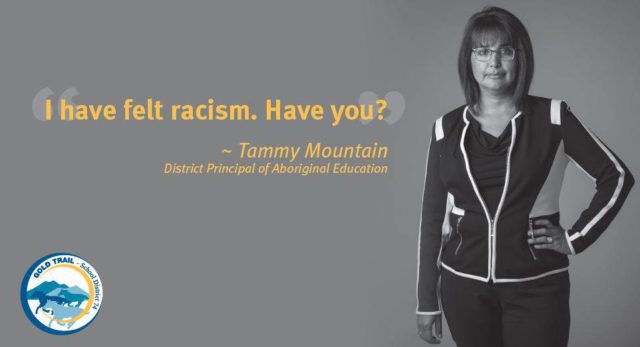
Kenny is especially upset about schools in British Columbia (BC) in the Gold Trail District that have put up posters challenging racism and white privilege. The Gold Trail District serves many students with Aboriginal heritage, and as we (should) know, structural racism continues to wreak violence in Canada. In the midst of alt-right reactionary propaganda, it’s also worth noting that BC has a long history of addressing racism in its curriculum without having created what Kenny calls the “devastation of identity politics” wrought by the Khmer Rouge and the Nazis (no joke, this is his analogy, which he steals from Jordan Peterson). This analogy, too, is a familiar white supremacist talking point. Anyone who argues that the systems in our society impact us differently because of aspects of our identity are distorted by alt-right propaganda and presented as ideologues cut from the same cloth as genocidal maniacs. The reactionary scare-tactics of the alt-right decry new and looming dangers - someone said ‘white privilege’! - when in fact, nothing new is happening (it’s a continuation of King). According to the Globe and Mail, “For many years, Downs said the district has been tackling issues of racism and colonialism, and has worked to follow recommendations by the Truth and Reconciliation Commission.” By trying to create a division between King and the long push for racial justice, and the current manifestations of the movement, the alt-right hopes to scare people into thinking that things have ‘gone too far’: whites are under attack!
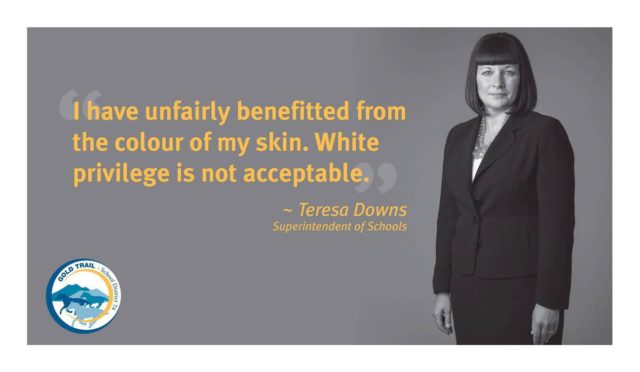
White fragility, the part of white supremacy that goes nuclear when anyone even says the word ‘white’, creates even more emotional labour when we need to explain to white people why they aren’t the real victims here. Because white privilege makes race a frictionless experience for white people, whenever minimal friction is generated through a conversation about whiteness, they perceive it as an attack, most often personally.
Sincere Kirabo asks what it says about people when they try to whitewash King’s legacy:
“Anyone with a genuine interest in better understanding King’s race-conscious racial analysis and his body of work beyond kumbaya “love is all you need” snippets placed on loop by mainstream culture would see the folly of this “I don’t see race!” belief system.
In short, unfamiliarity with King’s full message and political activism leads to feel-good symbolism that acts as anti-black propaganda.”
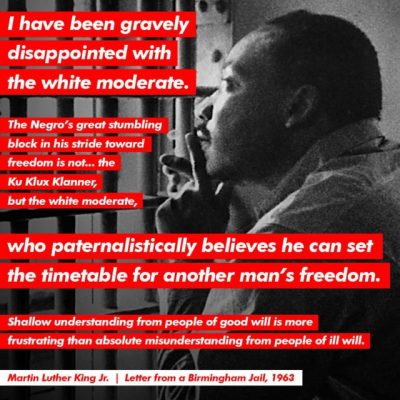
While Kenny opposes the “narrative of the oppressor and oppressed”, he ignores King’s caution that freedom “must be demanded by the oppressed.” The real danger, according to King, was not the KKK, but the “shallow understanding” of “the white moderate.” White privilege makes it possible to not even realize how certain acts contribute to oppression; white supremacy actively denies that oppression even exists. As Reni Eddo-Lodge articulates, this unwillingness to listen to people when they talk about injustices they have experienced stems from an emotional disconnection on the part of the hearer:
“I can no longer engage with the gulf of an emotional disconnect that white people display when a person of colour articulates their experience. You can see their eyes shut down and harden. It’s like treacle is poured into their ears, blocking up their ear canals. It’s like they can no longer hear us. This emotional disconnect is the conclusion of living a life oblivious to the fact that their skin colour is the norm and all others deviate from it.”
Here is Kenny’s response to my post (added by me on 19 March 2018)